Selected Neuroscience Artworks by Adam Sprague
Scientific Context & Artist Statements
Optics: The Physics of Perception
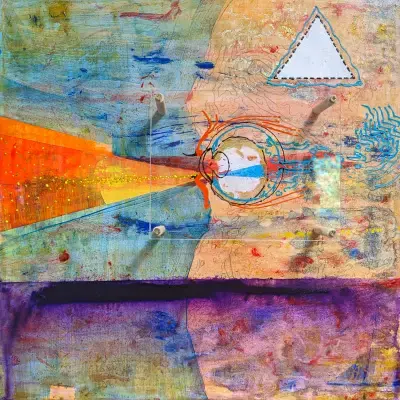
This is another piece where I used actual fMRI images of my own head as reference. As a visual artist, I am extremely concerned with both the physics & biology of vision as well as the concept of seeing. The term optics can refer to both the physics of light, and to the subjective appearance of something. Good or bad optics change the way people feel about eachother and the world. I'm very interested in exploring the idea that light carries more information to our minds than just the frequencies of the photons would suggest.
Using plastic, wood, and screws, this mixed-media piece deconstructs the physics and biology of visual perception. A transparent plastic overlay represents the anatomy of the eye in crossection (cornea, lens, orb & optic nerve), hovering above the surface of the painted panel. By letting the illustration of the eye literally transmit light, it becomes a structure that information freely passes through. The cone of vision, filled with individual points of color representing photons, is less than geometrically perfect. Lastly, up in the visual cortex I have left a placeholder. This is the missing piece.
Gestalt & Cognitive Closure
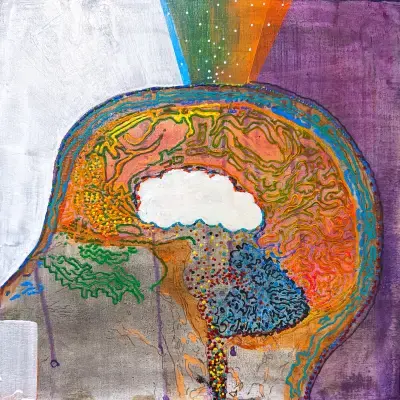
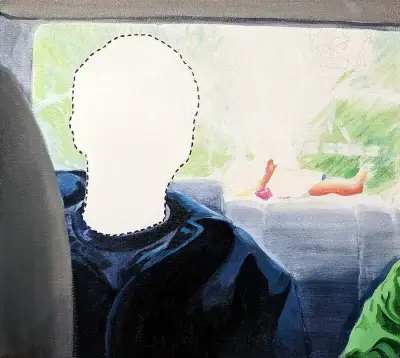
On the surface, I'm conflating the two ideas of cognitive closure (the psychological need for resolution after trauma) and the Gestalt principle of visual closure. Visual closure is rather simple: our minds complete lines and shapes that are visually interrupted. In the painting, I'm invoking this concept by outlining the figure's silhouette with a dashed line.
Cognitive closure, on the otherhand, can be a very painful. My need for cognitive closure relates to the loss of my best friend, some years ago. The loss was sudden, and I was young and unprepared to understand or process it. As far as I know, there was no public funeral. Every few years, I search for old obituaries as if to prove to myself he really is gone. He still visits me in dreams.
Jonathan Lasker said, "The viewer always completes the picture." What does that mean? The viewer is the last step needed to complete the meaning of an artwork. If that is true, I want to call upon the viewer's ability to visually close forms, to complete the form of my missing best friend. I'm hoping the viewer can complete the picture and finally give me closure.
Action Potential: Anatomy of Anxiety
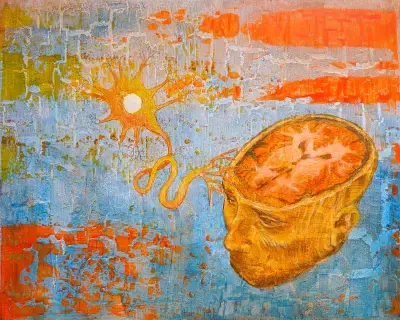
This work combines a self-portrait, based on my own fMRI cranial cross-section, with an oversized diagram of a neuron. By exposing the biological machinery (dendrites, axon terminals, and the cell body), I explore the concept of "action potential" not just as a voltage spike in signal transmission, but as a metaphor for personal potential energy. It visualizes the buzzing, anxious energy of the mind as a physical, electrical event.
The action potential is that subtle difference in electrical charge that allows the neuron to do its job: send a message. What is my potential energy? My life is full of buzzing, anxious energy that I cannot shake. So, at the same time that I am exploring the neurophysical reality, I'm also interrogating myself about my own potential.
Neurophilosophy & Cortical Localization
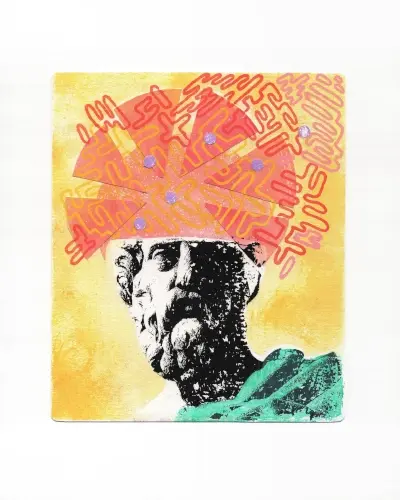
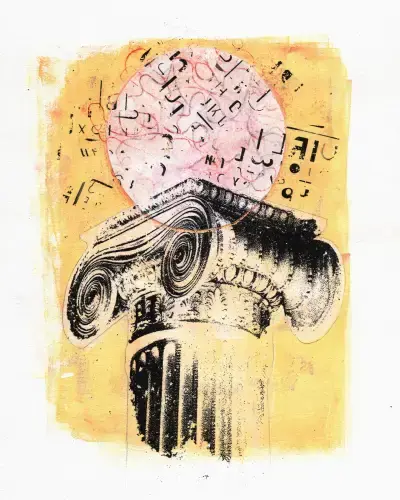
Created for GSU's Grey Matters neuroscience journal, these illustrations merge classical philosophical imagery with abstracted cortical localization diagrams. The works abstract the relationship between language, the foundation of philosophy, and the physical folds of the brain, questioning where the mind resides within the biological tissue.
Neuroscience & Art
Artist Statement
My work draws from lucid dreams, recovered memories, and altered states. I view my role not as a passive observer, but as an archaeologist of my own mind, diving into the deep catacombs of the subconscious to retrieve artifacts and offer new perspectives on emotion, memory, and consciousness. I am deeply interested in the overlap between art and science, especially how visual language can reflect the inner workings of the brain.
While my work is rooted in personal experience, exploring the creative potential of hypnagogia (the transition between wakefulness and sleep) and the malleability of memory, it frequently engages with hard science. Using painting as a foundation, I work freely in mixed media to visualize concepts like neuroplasticity, signal transmission, and the psychology of closure.
Alongside my studio practice, I create and curate projects that connect directly with neuroscience research. My work translates complex neural systems into visual form, often engaging with scientists to bridge the gap between the laboratory and the gallery. Through both my art and curatorial efforts, I aim to illuminate the ways in which consciousness constructs our lived experience.
Neuroscience Art Exhibitions Curated by Adam Sprague
Mind's Eye
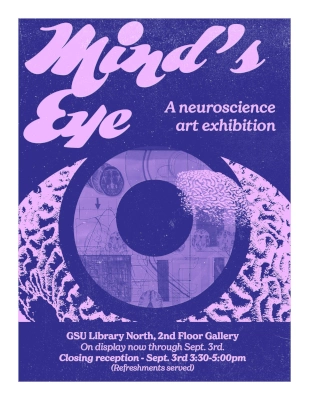
Mind’s Eye explores the dialogue and potential transformation that occurs when art and science unite. The exhibition challenges the academic silos that often separate researchers and artists, proving that visual language is a powerful tool for science communication. The exhibition featured collaborative works from artists and scientists at Georgia State University, brought together by the Brains & Behavior ArtSci Match Program. Conceived by Neuroscience PhD student Hannah Lichtenstein, this initiative fostered cross-disciplinary partnerships that bridge fields ranging from neuroscience to studio art and computer science. The resulting interdisciplinary pieces—which illustrate, are inspired by, or reinterpret scientific research—demonstrate how the artwork and research mutually elevate one another.
- GSU News: Library Exhibit Explores Art and Science (Note: This article covers both 2024 and 2025 exhibitions.)
Neural Impressions
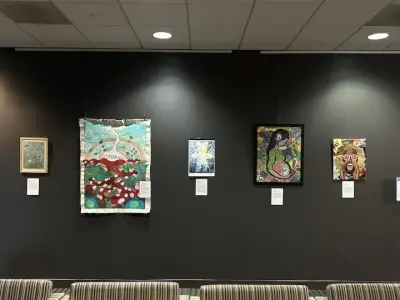
Neural Impressions showcases the confluence of visual arts and diverse fields of neuroscience, including neural imaging, visual perception, and psychedelic research, through the work of fifteen Georgia State University artists (students and faculty). Most pieces were created in collaboration with GSU scientists via the Brains & Behavior ArtSci Match Program, a cross-disciplinary initiative launched by Neuroscience PhD student Hannah Lichtenstein. The resulting artworks interpret and translate important GSU neuroscience research for the general public, highlighting the power of interdisciplinary collaboration.
View full list of neuroscience exhibitions curated by Adam Sprague
- 2025
- Mind’s Eye, Cocurator with Hannah Lichtenstein, Georgia State University, Library North, 2nd floor gallery, Atlanta, GA.
- Art/Sci Match artwork display, Cocurator with Hannah Lichtenstein, 2025 Brains and Behavior Retreat, Georgia State University, Atlanta, GA.
- 2024
- Neural Impressions: Illuminating the Brain's Beauty through Creativity, Cocurator with Hannah Lichtenstein, Georgia State University, Library North, 2nd floor gallery, Atlanta, GA.
- Art/Sci Match artwork display, Cocurator with Hannah Lichtenstein, 2024 Brains and Behavior Retreat, Georgia State University, Atlanta, GA.